WildernessPunk: Why are the Kids Inside?

What provides you with your inner strength? If I asked you this, you might list off the things which inspire and create the cornerstones of your life. Perhaps goals, projects, jobs, friends, and family would make the list. If you dug deeper you might move out of your normal lane and list more rugged skills like camping, hunting, bicycling, and hiking which provide you with a stronger inner core  through stepping outside of your comfort zone. Some people take it up and notch and increase their positive self-regard by extreme acts such as sky diving, swimming with sharks, or trying to find a decent date.

aa

Sure we can all list a few things we currently do or have in our lives which help maintain our self-esteem, but what about things which set the stage for who we are? What events fortified the foundations for who you became? What trails, which ended both well and badly, created the fortitude within you which helped establish the adult you are now?

Have you noticed how things which happened to us when we are younger are the most potent? How many of you reading this still listen to the same type of music you liked in your late teens? You are more likely to remember your first date or kiss than your 3,000th. Hopefully I am talking about kisses and not my 3000th date. That could indicate a problem.

Number of Television Watched

1111

Personally, I believe surviving challenges as a child set us up for success and a positive self-regard as an adult.  I’m not suggesting you let your preteen be chased by a bunch of deviant Taliban predators. The task should meet the skill level or… maybe surpass it by a few degrees. Challenge brings out the best in us and of course children are challenged in school, in social situations, and through various competitions. But this isn’t what I’m talking about.

First off, sports don’t count. It is a group being told what to do by adults set within a formatted framework of rules. Sorry, but saying, “Golly, Billy sure kicked a ball a lot tonight,” just isn’t what I’m talking about here. Again, most of school is just following rules like a billion other kids. Do this, learn this, follow these math and science rules of thumb… And unless the social situations end up leading to violence, this isn’t what I’m discussing either.

What I’m talking about is an unexpected and unsupervised test of one’s metal. I’m not sure what it is about natural challenges, but they often seem the most potent. Sure being chased through the city by murderous addicts would be intense and coming through it in one piece could help establish positive self-regard, but still cities, have police, distractions, rival gangs, hell you might be able to escape by just running up to a random door.

11111

Perhaps it is a throwback to our roots as a species, but facing an obstacle out in the wilderness is a whole different situation. Here are some reasons this could be.


Reasons why Wilderness Challenges are more Potent

  • There are usually few or no other humans present
  • Nature doesn’t give a shit, it can’t be reasoned with, and doesn’t quit
  • Often solutions are long ordeals and not quick fixes
  • The items you have are all you get unless you make yourself more
  • The skills everyone present possesses become more important
  • Simple things like fire, water, or a knife can save you
  • Lack of getting these simple things can mean your doom
  • Nature is the great equalizer, being rich or poor, black or white, straight or gay, conservative or liberal doesn’t matter to the bear, the sun, or the blizzard

Let’s get back to character building and childhood. If you are chased by addicts you can blame them, but you can’t blame nature. When it challenges you, you can only blame yourself if you fail. Conversely, if you triumph, no one can take it away from you. Cheating is difficult, and hell, even cheating is something you could be proud of when faced with a true challenge.

111

So how important is it to have respect for your own skills and abilities? How much do earlier childhood victories help shape who you are? I feel that knowing you can overcome obstacles, even smaller ones, independently, and owning the experience of winning out against adversity as a youth, can set the stage for believing you can do so again as an adult. If you have never been individually challenged, how would you know whether you could persevere?

Again these do not have to be huge tasks. I don’t recommend dropping your eight year old off in the artic, but knowing at an early age you have what it takes to kick it into high gear, problem solve, hang tough, and keep yourself and others safe gives children the positive self-regard which will help them make it through their much harder adult life.

But what if they aren’t challenged. How will they react to a random issue when they have no back up? Will they be lost? Could they feel they are ill prepared to tackle an issue which isn’t solved by a cell phone?

111111

“Kids are very nervous today—they have a lot of anxiety,” says child development specialist Rebecca Weingarten.  “We need to promote constructive failure,” says Weingarten. “Kids can’t be afraid to face the normal repercussions associated with taking risks.”

Another study from the University of Lethbridge in Alberta shows that free play actually changes the way the neurons in the front of the brain connect in a positive way.

So we know free play is good, but how does this translate to daily activities?

“It means no adults, no restrictions and no added rules during playtime,” says Thomas Dittl, a kindergarten teacher who is a big advocate of free play. “When you give kids room to explore and learn on their own, amazing things happen. I’ve seen this happen time and time again with my kindergarten students. They figure things out on their own. They learn how to share. They invent new ways of doing things. Even at a young age, it’s setting them up for future success.”  https://bit.ly/2KRNiiG

111111111

So we know adventure is good for the brain and body. I’m not advocating forcing your kids to do things, but they should at least have the opportunity to gain the esteem boost which comes with self-reliance and risk. In the end it will make them healthier inside and out.

Alright now, just for fun, I’m going to make a quick list of a few of the things I did or had happen to me before I entered High School. I hope my mom isn’t reading this.

My early childhood adventures/risks/challenges

  • Faced off against a vicious dog, armed with a pipe, on a ledge above an abandoned junk yard. Age 5
  • Escaped from several feet of quicksand. Age 7
  • Saved my brother after he fell through a fishing hole in the ice. Age 8
  • Found and excavated an old trash midden Age 9
  • Explored and mapped out all the woods I could reach between the highway and river where I grow up. Age 10
  • Kept my brother from being swept over a waterfall. Age 11
  • Chased off 2 buglers with a baseball bat Age 11 (They robbed my neighbors that night)
  • Saved friend who was about to be swept under in an ice covered river and then made sure he didn’t get hypothermia. Age 12
  • Explored an abandoned three story house. Age 13

I’m not trying to brag, but I can look back with pride and mark my earlier years by accomplishments and not by what level I reached in the Halo game my mom bought me.

writers-chair


You can check out some of my fiction here, where Detective Dak is placed in charge of the anti-clone task force. His main problem…. He’s dating one.


doorway

WildernessPunk: The Recycle Life Cycle

A few thoughts before I dive in. First, I know we all get hit over the head with the three Rs. The second is, since I’ve already covered Reduce and Reuse in the last few articles, we can fast forward to Recycle. Still bored… don’t worry I’m going to WildernessPunk this and get to the core of this issue. Recycle is the last of the our list of six ideas we can all accomplish to lower our Negative Environmental Impact (NEI)

Here’s a quick review of those six ideas

  • Minimizing Food Waste
  • Commuting by Bicycle, Walking, Buses
  • Use Energy Wisely such as high efficiency devices and keeping them unplugged
  • Consume less
  • Eating for a Climate Stable Planet
  • Recycle, Reduce, Reuse

Yep, yep Recycle. All of us do it, or at least I hope so. But are we recycling enough? More likely, we’re trying to recycle too much. Too much, one might think recycling is one area where more would always be better. We might like to think the Recycle fairies find some use for all the items we imagine we’re keeping out of the landfill.

But what happens to the items we put into our recycle bins which can’t be Recycled? Could we be creating more problems by trying to Recycle to much? What happens to things which can’t be Recycled when they arrive at the recycling department?

1

So are we doing more harm than good by Recycling more than we should? Chances are… yes. So let’s dig in and hash all this out so we can be good WildernessPunkers, shall we.

First off, what we can Recycle will of course vary from country to country, state to state, and town to town. So um, we’ll just focus on where I live. It might not be exact, but at least it will help educate us on a general system which should be close to accurate for most of us.

landfill_diversion_chart 11111

Like always, let’s strive to keep this simple and make a few lists. The first will be what we can recycle and the second will be things you might think are okay, but are not.

Commonly Recycled Goods

  • Cans, but make sure things like soup cans are clean
  • Plastic, water bottles, other drink bottles, clamshell fruit or take-out containers, rigid plastic like detergent bottles
  • Paper, junk mail (plastic windows on envelopes are fine), newspapers, office paper, shredded paper in clear plastic bags, and cardboard
  • Plastic bottle lids, but only if the bottle is dry and they are screwed back on
  • Plastic lunch containers, if they are clean
  • Cardboard cereal and pasta boxes
  • Aluminum foil, pie pans etc, but only if free of food
  • Milk containers, again as long as they are clean and dry
  • Shampoo bottles if clean and dry
  • Cardboard, but condense and remove tape
  • Glass jars, label can stay on but loose the lid

Old North Bridge

Items which cannot be Recycled

  • Plastic containers which have not been cleaned and dried
  • Styrofoam
  • Plastic straws
  • Juice bags
  • Plastic bags
  • Prescription bottles
  • Batteries
  • To go coffee and soda cups
  • Bubble Wrap
  • Pet food bags
  • Election Signs
  • Yard Waste
  • Hazardous waste, not in curbside, but some companies can help
  • Smaller items

Yes, I know some of this is a bit tedious, but if you really care about saving the Earth and stepping up to knock down your NEI, then this is good to know. Putting items into the recycle bin which can’t be recycled is much worse than tossing it into the landfill. It can break down the machines and cause whole truckloads to be contaminated and thrown into the landfill.

Also in case you were wondering…

“When done thoughtfully, recycling is cost-effective. Less energy is required to make products from recycled materials than to produce them from raw materials.” Benjie Sanders / Arizona Daily Star

11

And just for a fact teaser here are a few stats.

There’s a reason people say to recycle paper and save the trees. According to Waste Management, recycling 500 average phone books could save between 17 and 31 trees, 7,000 gallons of water, 463 gallons of oil, 587 pounds of air pollution, 4,077 kilowatt hours of energy and landfill space.  https://bit.ly/2JcL7JX

So I’m going to leave this here. Over the past few months, I’ve done what I’ve set out to do and covered, in a brutally realistic manner, what each household in the USA could, doesn’t, and should accomplish to lower our NEI as individuals and as a country. Of course more could be done and a greater insight gleaned with continued work, but more often than not, a simpler approach is more likely to succeed than an exhaustive data explosion.

recycle_chart1111

On a person note, I’m not sure about all of you, but I know I’ve learned a lot by collecting this information. We often suffer from accepted delusions and I hope I’ve helped pop a few erroneous thought bubbles.

I would also like to state, I’m pleased to have completed this process. Not only because of the positive benefits of sharing, but also because of some of the darker places my research brought me too. We have a long way to go, but as my uncle’s show used to say, “Knowledge is Power.”

And come on America, we got this. We’ve stepped up before and we can do it again, especially when this might be the most important thing our species has done in 10,000 years.


poker


You can check out some of my fiction here, where Detective Dak has to decide between is lover and his job, but will either choice be able to save them?


archesss.jpg

WildernessPunk: Getting Rude About Food

Looks like I took another mini break from WPing after my last camping adventure. What have I been doing besides bingeing on ‘True’ Horror stories and proofing my newest novel which probably will never be published? After celebrating Patriot’s Day, I also hit one of the rare and lonely rivers which cuts through southern Arizona, the San Pedro. But enough about me, for I intend to finish something I have started. I hope my parents haven’t just fainted.

San Pedro log

What I’m talking about was addressing the list of the 6 things we can all accomplish, within our urban environments, which will help lower our Negative Environmental Impact (NEI).

Here’s a quick review of those six ideas

  • Minimizing Food Waste
  • Commuting by Bicycle, Walking, Buses
  • Use Energy Wisely such as high efficiency devices and keeping them unplugged
  • Consume less
  • Eating for a Climate Stable Planet
  • Recycle, Reduce, Reuse

And as at least three of you might know, number 1-4 have been covered bringing us to… Eating for a Climate Stable Planet. No, I’m not coming for your hamburger, but I do intend to toss some data out there. But before I do…

I’ve noticed some interesting things since I’ve begun to seriously investigate our NEI. (Some of you might want to stop reading now) Most of the people I associate with all claim to be environmentalists and interested in helping the environment. But despite their claims, they do little more than the average Trump supporter to accomplish anything to really reduce their NEI. Most people, recycle, have maybe one small pet project, post a few anti-pollution memes on Facebook and call it a done deal. Meanwhile, in this country, the average person pollutes about 200 times more a day than someone living in India. Think about it, chances are, if you’re reading this, you’re 200 times worse than someone living in a more traditional environment. If we went back 10,000 years your current lifestyle would be causing about 1000 times more damage than Rutroo the Barbarian.

rutroo

I’m not demanding you change, but unless you’re living in a tent in Alaska, I think few are the Americans who can claim to be environmentalists. “Hello, I’m part of the worst polluters the world has ever seen, but I’m an environmentalist.”

Still, what are the, would be, heroes of the Earth to do?

I hope we wish to do more than admit we’re hypocrites and wander off mumbling.  Part of having to power to change is the knowledge of how things currently are and what could be done. This being said, let’s look at the environmental cost of what we eat. Buckle up people, because for most of us, this is going to hurt.

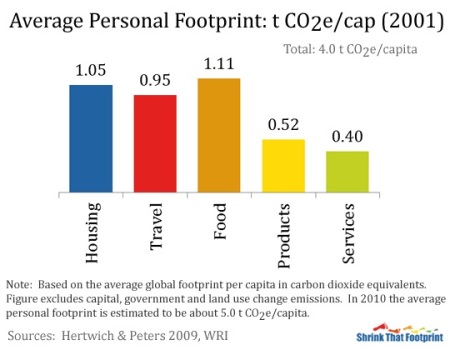
Many may remain unaware the consumption of food creates to highest NEI for humans. It beats out the resources we use for running a house and transportation. So if eating creates the highest impact on our environment, rethinking and adjusting our eating patterns might be the easiest way for each of us to lower our NEI, or is it?

personalfootprint1

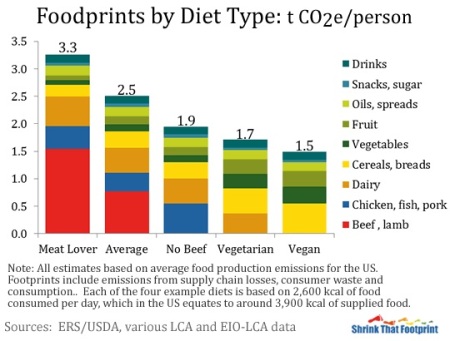
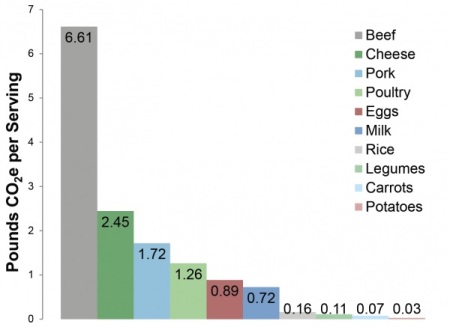
Obviously the first, but perhaps not the easiest step, would be for as many humans as possible to become vegan or at least vegetarian. Yes, this would help, but it’s really not so simple. For instance the difference between low meat eaters and vegetarians is only a 12% drop. This is great and if everyone did this, terrific, but this still doesn’t address the remaining 50% NEI vegans create. Even the difference between a guy who eats a steak every night and a vegan is only double. It seems strange you have to change your whole life, and make things rather difficult for yourself in multiple ways, just to cut this in half and then be stuck. We just can’t lose this 50% best case scenario NEI creation… or can we?

foods-carbon-footprint-7

So if we’re looking at a 50% NEI even if we’re trying our hardest with what we eat, lets looks at where this 50% comes from. It isn’t too complicated. Plants and meat cost energy and resources to produce. Then more to prepare and package. Then still even more to transport to our local store. Then a bit more to remain in a temperature controlled building until we purchase it. Still not done, even at our home we’re using energy to keep the refrigerator running and then cooking our yummies for consumption.

Since this is a lot to take in, I think we would be better tackling these one at a time. So here’s the list of


Food’s Baseline Negative Environmental Impact

  • Food Production
  • Food Preparation
  • Food Packaging
  • The Transportation of Food
  • Housing Food
  • Maintaining Food


Food Production:

We already know producing meat can up to double your NEI, depending on how much and what type you eat regularly. But whether you’re vegan or on the cowboy diet, this is still contributing to your food’s baseline NEI. Eating less meat will help this greatly but as previously stated the difference between a light meat eater and a vegetarian isn’t huge.

WildernessPunk Suggestions:

  1. Grow your own food, raise your own animals, and reuse grey water to do so whenever possible.
  2. Eat foods which require less resources and energy to produce.

a

Food Preparation:

Apparently this is considered part of the food production process, although producing food seems different than preparing it to come to us. Interesting to note, whether one’s vegan or on the Cowboy diet, this is one the highest producers of NEI through the food cycle, if you include huge amount of food waste which occurs as is mentioned in WildernessPunk: The Number One Thing.  https://bit.ly/2KVVHGQ

WildernessPunk Suggestions:

  1. Grow your own food, raise your own animals, and reuse grey water to do so whenever possible.
  2. Do not shy away from purchasing food which appears imperfect.


Food Packaging:

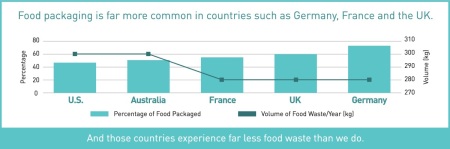
There is less data available in regards to what percent of a food production of NEI is creating by its packaging. One interesting trend appears to be the more (better) food is packaged, the less food is wasted. Still part of me wonders how our dystopian ancestors will feel while walking through fields of Styrofoam when they hear “They had to make everything as perfect as possible for three generations or so and placed Styrofoam under each piece of meat. This helped people live to an older age, so they could pollute even longer, now go eat the caterpillar paste out of the communal pot and remember to share your fork with the whole village.”

WildernessPunk Suggestions:

  1. Buy bulk when possible, but be sure not to do this if it creates food waste.
  2. Attempt to buy food with the least amount of packaging possible.
  3. Recycle, reduce, and reuse this packaging as much as possible.
  4. Buy unpackaged foods.

FoodPackaging-CountriesChart

Transportation of Food:

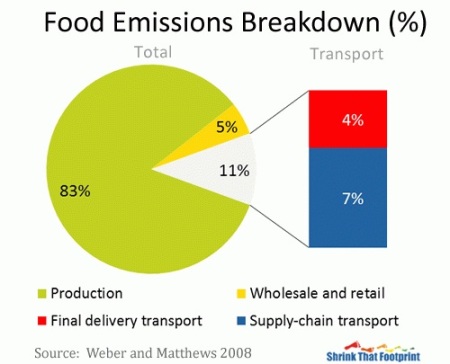
This is where vegans create as much NEI as the biggest carnivore. It appears transporting food creates roughly 11% of its NEI and is in many ways what we might have the least control over, but let’s take a stab at it anyway.

WildernessPunk Suggestions:

  1. Grow your own food, raise your own animals, and reuse grey water to do so whenever possible.
  2. Research what types of food are produced near your area and try to eat these whenever possible.
  3. Buy food at local markets.
  4. Avoid exotic foods.

foodemissions

Storing Food:

This appears to be the smallest producer of NEI. Only 5% of the overall NEI is created by maintenance and storage.

WildernessPunk Suggestions:

  1. Use energy efficient transportation when buying food.
  2. Smaller more focused trips to the store help reduce food waste.
  3. Research which of your local stores are more eco-friendly.


Maintaining and Preparing Food:

The average citizen of the United States’ use of electricity makes up 14% of their NEI. Refrigerators make up only 8.8% of this. So roughly  1.2% of our yearly NEI is created from refrigerator use. Which is probably one of the most reasonable uses of energy in our country. This is only increased with the knowledge the best thing we can do to lower our NEI is to limit food waste. (See WildernessPunk Number One Thing) Also interesting to note our refrigerator use alone produces twice the NEI the average man in India creates with everything he does.

Cooking food creates slightly less NEI than refrigerator use and is easier for us to avoid by purchasing more food which doesn’t need to be cooked.

WildernessPunk Suggestions:

  1. Keep refrigerator on a higher temperature.
  2. Be efficient when removing items.
  3. Try to compost food which gets too old to eat or feed it to animals.
  4. Try to avoid buying more than you can eat before the food goes bad.
  5. In most cases, give the expiration date on food an extra week or two.
  6. Eat food which requires less energy to prepare.
  7. Recycle time saving products which are big energy wasters.


Food Production is one of the hardest things for the average consumer to influence. Of course, limiting your meat intake is the best way to lower your contribution to our NEI. Producing as much or your own food as possible is also a strong play.

This may seem like a hard bunch of data to take in, but if we think of things as a national effort, we would start looking at huge improvements. If as a country, we could produce 20% less NEI the effects would be staggering. And as always keep in mind all these improvements, help the environment, our country, and our personal finances. We have nothing to lose but our NEI.

I think its time to wake up and get started.

Garden

oi.jpg


You can check out some of my fiction here, where Dak has to decide between is lover and his job, but will either choice be able to save them both?


San Pedro north

WildernessPunk: A Spring Thing

You know what? I think it’s time I take a break and mix it up a little. My last four or five posts have been rather serious and… it’s Spring. Coinciding with this fresh get out of the house feeling I have, is my first solo camp of the year and a renewed decision to avoid banging my head up against the steel wall of what our current politics has become.

Sometimes you just need to shed yourself from all this damn humanity. Ergg, we’re all so narcissistic and self-important. Humans do this. Humans want that. Humans are entitled to… Sometimes I just want all the talking heads to shut up, but since they never will, I’ll just take myself to a place I can’t hear them. Here, by the edge of the Gila River, it’s just the murmuring current and the talking beaks.

Gila camp

Strange how moments alone, especially when off the grid, allow and perhaps force one to reflect. Spring is important to animals. As one, we emerge and renew our methods used for The Strive.

The Strive: Whether personal or natural, the search to find the techniques and methods which will allow us to complete our goals.

gila rapibs.jpg

Could focusing on what your Strive was through different stages of your life help you to look back and chart your growth or at least your adventure? What was your Strive last Spring, the Spring before that, and the proceeding one? Should someone have a Strive which progresses through the years or would this be little more than stagnation?

For the sake or creating an outline for reference, I’ll toss up my last three Spring Strives, which have occurred since WildernessPunk began.

  • Last Spring: I was evicted and had new goals only months after finally having a new foundation.
  • Two Springs ago: I was preparing to escape the clinging fingers of the mountain town I’d called home for so long.
  • Three Springs ago: Evil acts had cost me seeing my children, my job, my vehicle, my home, and started me on the WildernessPunk journey.

This spring well… I know I need to change, improve, and evolve, but no dread and doom looms over me. No fist of dismay, hovers through my waking thoughts remaining me of faults and malingering problems. Of course many still exist, but not the crippling kind which cause you to live within a rotting tent in the woods.

Gila North

In the end what motivates us more, having it all yanked away or enjoying the support of a stable environment? This is an interesting question. Let’s break down to possible pros of each situation.


Aids to accomplishment provided by a Fortified Environment


  • Utilities allow one to work during any hour of the day
  • Enough food and water provide the strength to work longer hours
  • Rooms designed for purpose and equipped with gear allow for a larger range of accomplishment
  • Less time is used for daily maintenance needs
  • Emotional support and pleasurable pursuits help recharge the soul


Aids to accomplishment provided by Challenging Environment


  • If isolated, less distractions could be present
  • Many luxuries which eat time such as televisions and the internet may not be present
  • Living closer to the edge can create a burning desire to improve one’s situation
  • One has more freedom to explore various paths
  • Exploring diverse paths is more likely to provide greater inspiration and sometimes opportunity


These are just a few ideas, but it really becomes a balance between equipment and inspiration because people can be inspired by different things. Many are those who can be inspired through the works of others. When this is the case, a stable environment allows for more information to be absorbed, but also you can only read one thing at a time and even at my worst, I’m never without a book.

gila paint.jpg

Still it can mostly come down to the person and like so many things is really a dual between law and chaos. What helps you succeed more, an organized house, complete with food, and temperature controlled, filled with all the supplies you need to get the job done? Or does the same four enclosed walls start to wear on you and leave you feeling uninspired as each day your experience drifts you further from any interaction with the True Environment?

For others, traveling, meeting new people, and seeing new beauty and places recharges the mind and leaves one eager to get started on the new adventure or project. Others find the time it takes to survive and travel through such areas a drain on their physical and mental resources and will get little done other than just making it through the day and then falling onto their cot exhausted.

gila Chair.jpg

Of course age and other factors affect such things. A retired man might very well get more done on his computer in a comfy chair, while a younger woman might try to stay within her apartment as little as possible.

So which are you, a more lawful based person who thrives when you’re in your comfort zone, or a chaotic person who likes to explore the new and the different?

Something to think about as you Strive to achieve the goals which stretch before you, for life is a short ride and we should all be sure we’re traveling along the right road.

Gila me.jpg


You can check out some of my fiction here, where Dak has to decide between is lover and his job, but will either choice be able to save them both?


gila tunnel

WildernessPunk: Consume

You may know I outlined the top six techniques the average person can step up and try to accomplish to help themselves lower their Negative Environmental Impact (NEI). Fourth on our list of environmental doom, is our desire to consume.

California

For many of us this can become difficult because it contradicts the generally accepted Cultural World View in this country, and much of the world, which states more is better. Our whole lives we’ve been told; make more money, buy more things, experience more of the world. This is designed to light a fire under us, but really lights a fire in the middle of our environment, because as I outlined recently in WildernessPunk, the Use of Juice, the more money one has, the worse their lifestyle is to the environment and the larger their NEI.

But let’s steer the rhetoric away from the use of utilities (and food which we also covered) and for this article, focus on the concept of how much material goods we consume. Since a huge amount of energy goes into producing the items you consume and transporting them to you, obviously purchasing less and using them longer will not only help your wallet but also the environment.

So here comes the jingle, recycle, reduce, reuse. Consumption is where this comes to play. However, it should probably go reduce first. Reduce what we need to use before we even start. Reuse everything we can whether we buy it, find it, swipe it, or harvest it. Then, after all this, it would get either recycled at the curb or donated to a thrift store.

Waste-management-hierarchy

So yeah, yeah, blahbahidyblue, you can find these ideas in a lot of places, nothing too radical here. Alright, where does WildernessPunk fit in? Probably in the battle between reuse and hoarding. Hoarding is mostly bad and nasty. Remember the above, having more makes more waste, so we shouldn’t strive to have more, but also we shouldn’t be part of a replacement culture either. Oh it broke, get a new one. This isn’t helping. I’m not saying we should keep the broken VCR in the closet, no, recycle such things.

half-done

Where things get tricky is how far do you go in keeping things around to reuse. We don’t want to live within piles of slowly rotting crud or have back yards which our neighbors wish to condemn, but also having a little extra doesn’t hurt the environment any. Everything we reuse saves a huge amount of energy. We should have the right to be able to reuse our gear, but I also don’t want to be the crazy guy keeping the plastic buckets with no bottoms. So where do we draw the line?

chaos star


This has always been a tough question for me. On one hand, I hate throwing things away which can be reused in some manner and having the supplies you need in the middle of a project is a huge boon. Finding a way to reuse some old thing you have saves time, money, and helps lower your NEI. Yet, hoarding sucks. Having too much junk is a pain in the ass. Personally I enjoy the Spartan look for rooms where I live. I might not always achieve it, but I like it.


So what is the answer?


Let’s try to bullet point a positive outline for this conundrum.


  • Start by owning less. Less mess and less waste automatically happen.
  • Be obsessive about using everything you can instead of buying something new
  • Stay organized so you know where the gear you could reuse is
  • Donating things to charity is another way of reusing
  • Gift things to friends
  • Go through your older things often and reuse, donate, organize, and purge
  • Actively use stored items for utilitarian purposes and art

unnamed


If you keep these concepts in mind, I don’t think things will get too bad, but it does bring up the thought, where again, lessening your NEI is not always a pretty thing. If you’re dumpster diving for lumber, instead of buying it, because you want to make a Tiki Lounge, it may not look terrific piled up against your neighbor’s fence while he waters his manicured lawn. But then again, if you’re living right, your NEI for lawn maintenance might be about a hundredth of his.


The bottom line is usually the less income you have, the less of a NEI you create, but it doesn’t have to be this way. One can use those extra resources wisely and create a place of beauty, which lives in greater harmony with the Earth. Create beauty, promote life, and also remember, if you have to move, less is always more.

Kopapelli


You can check out some of my fiction here, where they power everything with nuclear, who knew?


Recycle

WildernessPunk: The Use of Juice

A few weeks ago, I reviewed six of the easier techniques we can use to save money, strengthen our economy, and help preserve the environment. The third of these techniques which helps minimize our Negative Environmental Impact (NEI) is:

Use Energy Wisely such as high efficiency devices and keeping them unplugged.

Makes sense right? But let’s be careful to be realistic here, because I think some of these concepts are not thought through completely and some people are getting more credit than they are due, while others have a smaller NEI and they aren’t getting the accolades they deserve.

a

I’ve often heard the praises of what I called Privileged Purchasers. Here was the definition I tossed out 4/17/17

  • Privileged Purchasers: These people feel they are ahead of the pack because their new custom made home has an energy efficient dishwasher and since they have solar power, the average person could never hope to be as cool to the environment as they are.

As I have pointed out more than once, does having an energy efficient home cancel out the larger NEI a person with a high income produces, because let’s be clear, in general the more income one has the higher their general impact. And before we consider how true this is, let’s also think about this world-wide. An individual living in a low income rural village has a very different life than say a middle class man in the USA, so let’s try to take a global perspective here.

Mount Gram

So let’s imagine two people. One is Brian Whitney, who is worth a hundred thousand dollars and just bought a new home with energy savings devices. Good for you Bri, at least you’re trying, but when we consider his life overall, is this lessening of his NEI even worth mentioning, compared to Ari Bhaat, who lives in an agricultural community near the base of the Himalayas, NEI? Could Ari be kicking Bri up and down the street just by being poor?

Let’s consider each lifestyles pros and cons.


Brian Whitney’s Negative Environmental Impact


  • Drives an average of 150 miles a week.
  • Heats or cools his home throughout the year
  • Uses electricity, natural gas, and water daily
  • Buys food transported long distances
  • Eats luxury food items with a higher NEI, like meat
  • Buys complex devices and manufactured items
  • Wears more intricate clothes and personal items

POSTER_bulk_carrier_1_jpg_1024x1024

Ari Baat’s Negative Environmental Impact


  • Eats local food, but more plants than meat
  • Does not drive, uses bus for long trips on rare occasions
  • Does not use electric heating and cooling
  • Uses some electric power
  • Wears simple clothing
  • Buys manufactured tools


Ari would have a household carbon imprint 0f around 200kg. https://bit.ly/2XL6A0w

The average American’s carbon footprint per person in 2014 was 21.5 metric tons CO2 or 21500 kg, so Brian creates 107.5% as much as Ari      https://bit.ly/2xAdeer

Per-Capita-CO2

But wait, what about the dishwasher Brian bought?

An energy effect dishwasher saves 40$ a year over washing dishes by hand, and reduces 50% of washing dishes NEI, but since washing dishes is roughly 1% of a home’s energy output, which is 14% of Brian Whitney’s carbon footprint, this is reducing his Carbon Footprint by 15.05kg  (.5 of 14% of 21500kg = 15.05kg) or about 7% of Ari total NEI. But also keep in mind this only lowered Brian from 21500 to 21,484.05 kg. Wow, those energy efficient dishwashers are so not amazing.

average-american-footprint

540g CO2e: by hand, using water sparingly and not too hot
770g
CO2e: in a dishwasher at 55°C
990g
CO2e: in a dishwasher at 65°C
8000g
CO2e: by hand, with extravagant use of water

https://bit.ly/2XNEsKi

dw

Let’s give Brian one more chance. Solar panels. And look, I’m a hundred percent in favor of solar panels. I wish we all had them. I’d love to flip the bird to the electric company and help withdraw our country from dependence on fascist theocracies. Electric cars, running my laptop like an anarchist, let me at it.

Utah Action

Still if roughly 14% of our NEI comes from an individual’s  use of electricity, even if we fueled 100% of our home with solar, that would leave 18,490 kg a year for the average USA adult. We saved 3,100 kg or a little over 15 times what Ari produces in a year.

Look I’m not saying don’t try to do everything you can to reduce your NEI and increase your freedom against the Bills. I just want to spin the chair until we are seeing the reality of what we’re facing if we wish to lower our NEI and wish to point out again, in general, the poorer a person is, the better they treat the planet. So the next time you see a homeless guy, suck it up and admit then it comes to being an environmentalist, he’s kicking your ass.

Bone hat

You can check out some of my fiction here, where they power everything with nuclear, who knew?

4104821-JESMTRAS-6

WildernessPunk: Park then Bark

A few weeks ago, yeah yeah, I got distracted, I spoke on various ways we can limit our Negative Environmental Impact (NEI). I’ve already tackled the first one on the list, (The Number One Thing https://bit.ly/2S6p8IB) where I discuss the serious cons wasting food creates. Today, I’m going to leap into number 2 on the list, non-vehicular transportation.

Whether it is on foot, rolling with the bicycle, or to a lesser degree, public transportation, there are many ways we can leave the car parked and perform tasks, both fun and obligatory, without turning the key in our automobiles. But before we dive into wildernesspunking this issue, let’s just review all the upsides of non-driving, but still getting to where you need to go.


Bike Back.jpg


The Positives of Non-car Travel


  • You lower your NEI
  • You save money by not using as much gasoline
  • You stay in better shape with more exercise
  • Reduce wear on your vehicle prolonging its life
  • You reduce traffic congestion
  • No need to find or pay for parking
  • Less driving means less accidents


bike.jpg


Bonus WildernessPunk Values


  • Less laws which you can be accused of violating
  • You can be more relaxed if you’ve had a few drinks
  • You don’t risk giving your money to a fascist dictator or to a company owned by the wealthiest .1%
  • You are more likely to observe nature
  • As the hippies would say, there is always the chance of finding a ‘Ground Score’
  • No one can ask you for a ride home
  • With enough change, parking lots could be converted into more useful spaces


These lists could continue, but I think you get the point. This is good for you, the country, and the world. But what should we call this style of improving? I hate the use of Alternative Transportation. Cars are alternative transportation. Walking is our normal mode, although we tend to forget such things. So how about we use:

Smart Travel


Bike wet.jpg


I would be surprised to find too many people who are against all the positive gains listed above. Although, of course, there will always be those who hate bikers and feel pedestrians just get in the way of smooth flowing traffic. They should keep in mind though, each of these people they see are one less car slowing them down when they are trying to make the light before it turns red.

More realistic objections would be things such as health restrictions, which could keep some people from being able to walk or bike to the store. No, grandma please don’t get on a bike, but it does bring to mind how far we’re removed from the natural, when people can’t live without the help of dead dinosaurs. Also in a strange reverse of fates, we unnatural city dwellers can perform many tasks without driving. For instance, I can do all my shopping, hit a restaurant, drop by the bank, and visit half my friends without getting behind the wheel.

bike lilly

In contrast, those who enjoy and live closer to nature, have the drawback of not being able to do the majority of our modern tasks without a long drive into town. If they can get wifi, many of these errands can now be done over the internet, such as paying bills. However don’t get trapped thinking you’re helping lower your NEI by ordering from Amazon, because that truck had to drive to your house.

Let’s review one man’s savings, er mine. I’m a bike commuter, who has obviously had the miles I ride fluctuate over the years. The most I ever pulled off was 4100 miles in a single year. But let’s lower the bar a few degrees below my crazy. I’ve had several years where I estimate I saved about 800$ a year. I minus the price of new tubes, but also keep in mind less oil changes and car maintenance.

walking

Sure 800$ might not be a lion’s sum, but then again, I didn’t need to sign up for a gym or take blood pressure medications either. But at the end of each month, when I walked down to a local pub with my extra 75$, I didn’t waste, and grabbed a pint and some chicken wings, it didn’t feel too bad.

So WildernessPunk it to the oil man and Mohammed bin Salman bin Abdulaziz Al Saud. Keep yourself out of the hospital and enjoy the extra cash in your pocket. Smart Travel is Punk, and every time you drive, a little of you has sold out. Little is more radical than Doing It Yourself and each time you take a stroll that’s exactly what’s happening.


Never underestimate yourself and be sure to look both ways.


bone shadow


Grab some of my ‘Does Dak dream of electric cars’ fiction here


skinjumpers

WildernessPunk: Solves the Immigration Issue

Since this is such a hot issue in the USA, as well as many other countries, I figured I go ahead an offer a quick solution. You might not agree with it, but you can’t argue it wouldn’t work.

So please accept this tongue in both cheeks approach to using facts and logic to solve things in a manner few would accept. But if you don’t, you can’t blame me when you keep getting into debates over the subject later…

My idea is as simple as it is effective.

The USA will only allow Atheists to immigrate to this country.

Chochise Pools

Okay, before I start to get some people’s blood up while others are finishing an incredulous chuckle, let’s just look at this logically and consider the abundance of pros and the absence of cons.


Results which appeal to the Right


  • Will drastically slow immigration

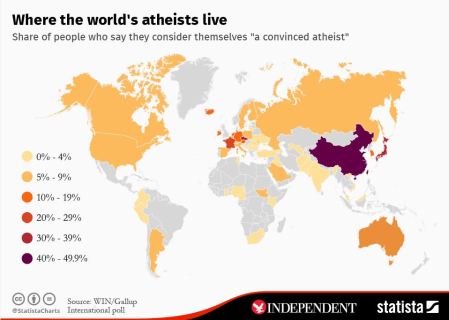
Since only 7% of the world’s population are atheists this would cut out 93% of immigrants, this would be way better than a wall.


  • Only 16% of Latin Americans are Atheists

Again, this would all but solve the issue the Republicans are so worked up over. https://bit.ly/2XciCQd


  • It would greatly reduce the chance of any religious extremist entering the country.

.

atheist-1024x682


Results which appeal to the Left


  • Immigrants will be more Progressive

Open minded, science oriented immigrants will only strengthen the Democratic party and help develop progressive policies which will advance the green agendas, support science programs, and help foster technological developments.


  • More Atheists are Democrats

Since Republicans are 18% more likely to believe in Gods and 8% less likely to be Atheist, this policy would be help boost the Democratic Party. https://pewrsr.ch/2T4Spnt


a


Results which appeal to the Wildernesspunks


  • New Immigrants will be nearly Crime Free

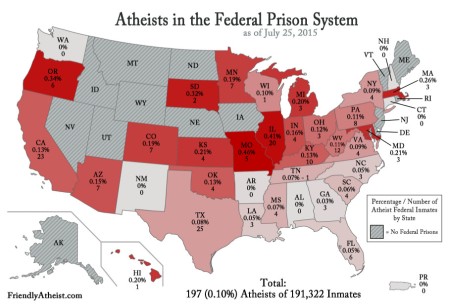
Currently .07% of the US prison population identifies themselves as atheist. So this is roughly 7 in 10,000. So every immigrant who enters the country increases the overall safety of the USA. https://bit.ly/2RUidCX


  • Facts Help

When someone believes in facts and knows this is the only life we get, they are more inclined to care about our planet and think about ways to preserve it, instead of thinking it is just a magical tool given to us to use until we live a cozy eternity in a sweet special happy place.


religion-statista


So why am I going here?


Let’s start backwards.

  • Trump is hurting the USA, some other countries, and the earth itself.
  • Trump is not the problem, but a symptom of the problem.
  • What is the problem?
  • Roughly 1 in 3 Voting USA citizens still support his evil man and he wouldn’t have been elected and be our problem without their support.
  • The majority of his supporters have been raised to believe bronze aged myths are true, should control our ethics, laws, and political policies.
  • People who partake in Magical Thinking, swallow impossible lies, and easy answers, will be much more likely to swallow nearly impossible lies and easier answers.


Tucson trail


Conclusion:

Religions sets people up to be easily tricked and controlled and are being used by evil men to further their own aims, which include, much more often than not, putting their own acquisition of wealth and power over the needs of humanity and the health of our planet.

So let’s try to move away from misguided advocates of the few myths we haven’t put behind us. Even the most pious follower of Christianity, Islam, Buddhism…etc is 99% atheist since there are far many more deities they think are false (Zeus, Odin, Hermes, Inanna etc) So they just need to add one more to the list to catch up to the heroes working to save this planet.

The USA could lead the world in so many powerful and wonderful ways. Yet, instead, we are being dragged down by people seeking to move backwards rather than forward. Truth is, we can’t go backwards. The world is different. There are more people than ever before and we are more industrialized than ever before. In most places we are more interrogated than ever before. These things won’t change barring, complete collapse or genocide, which if we were to stay on this course, could be looming in our future.

Or we can shed the heavy chaffing belt of ancient myths written for the technology and morality of another time and look toward the type of innovations in science and technology which will allow our economy, race, and earth to thrive and… with a little luck survive.

Thanks for listening.

.

Bone with box i

.

You can grab some much less opinionated fiction here

.

little-camp

WildernessPunk: Lessening Our Negative Environmental Impact

I’m hoping most of the folks reading this also read my last WP post, The Number One Thing, where I discussed how the easiest thing we can do in this country to combat Climate Change is insuring we minimize food waste which causes huge amounts of methane to enter our atmosphere. This limits our personal contribution to climate change while helping our country, and also our personal finances along the way.

Josh

But how do you top a concept which can be embraced by everyone cross culturally which also has a huge positive affect on everything from environmental health to blue collar worker’s wallets?

The answer would be to find something even better.

But first I wanted to toss out a Mission Statement of sorts for WildernessPunk, you know because we’re so professional and all:

WildernessPunk is the concept of moving past accepted norms in the pursuit of engineering a life which minimizes our environmental impact on our planet.

Valley of the Goda

A little more WP Housekeeping. For the Hell’s of lit, I went ahead and started a WildernessPunk Blog and FB page. I’ll start posting an old posts on both of these every day. I’ll still post new WP posts here on my main page, but in the future there will probably be a benefit having them all in the same place.

So back to this find something better concept.

Chocise

There are many different lists and suggestions to be found on the internet and within the reports written by environmental scientists. However, many of these lists involve legislation and making huge sweeping changes in our technology or culture. But what about things which rely on the individual? What could you do tomorrow to help without needing to call your congressperson, collecting signatures, or investing a few thousand dollars?

Let’s compile a list of the top contenders. I know we talked about minimizing our food wastage, so I’ll just place this at the top of the list.


Ways an Individual can Lower their Negative Environmental Impact (NEI)

  • Minimizing Food Waste
  • Commuting by Bicycle, Walking, Buses
  • Use Energy Wisely such as high efficiency devices and keeping them unplugged
  • Consume less
  • Eating for a Climate Stable Planet
  • Recycle, Reduce, Reuse
  • And Eating Bugs


Bike wet rain

After a review of the current literature, this is the list of top things we can each do on our own which were mentioned in the most of the various articles. Of course there are dozens of things we could do as a party or a country or a world, but most experts agree individuals should be doing as much of the above list as possible.

I might blow off the eating bugs idea. I mean it’s just so simple why outline it, unless you want to discuss how to build ant farms for fun and dinner. However, since I already started with the first one, I might take a WildernessPunk crack at the others. Perhaps we all might learn something.

Old Faithful


You can grab some of my fiction here, check it out.


bone empty lecture

WildernessPunk: The Number One Thing

After my last adventure, I feel refreshed and ready to change the direction of WildernessPunk down a different one of its Arrows. This time diving into the issue of Climate Change. You know, the whole thing about keeping our planet alive.

Often, in this stage in human existence, we’re informed of and confronted with the ills which infect our world. Usually it becomes overwhelming and we feel powerless to have any serious impact on the situation. Yet, if it is an issue, such as Climate Change, which is caused by each one of us, couldn’t each one of us to do something to help?

a shot

It makes sense. If I contribute to a certain percent of an issue, let’s say X percent. Then my behavior should then affect X of this issue. If we all change our X percent, then we have changed the whole situation for the better.

Sure, I understand each of our contributions to Climate Change in theory runs about .000000013%, however if you multiply this number by digits which end in a lot of zeroes this can change quickly.

So, as mentioned in the title, what is the Number One Thing we can each do to reduce our contribution to global warming? The answer changes from country to country. In less industrialized countries the answer is to educate the population on reproductive options. I’m also going to mention another huge factor which would help underdeveloped nations, since it will relate to the #1Thing in the more industrialized countries.

.

global-warming-emissions-by-sector

The other big issue in underdeveloped countries is food waste. But unlike how food gets wasted in countries like the USA, in less developed countries a huge percentage of food goes bad before it can reach the consumer. So better preservation, along with transportation and reproductive education, are key components to lowering how underdeveloped countries contribute to Climate Change.

But things are different in the more industrialized countries such as the USA. Here, more food is wasted after purchase and is sent to rot in the landfills. This rotting food is one of the primary causes of methane which our NASA lists as the third leading greenhouse emissions on the planet. https://climate.nasa.gov/causes/ Whether it rots on the way to the store or after you toss it, the results are the same. Our titanic production and wasting of food are one of the leading causes of Climate Change.

0000000000000000000000000000000000000000000000000000

Yes, there are many ways we could all help lessen our Carbon Footprint. We could become vegan, ride our bikes to work, and use our cooling systems less, but each of these things have something in common. They would all involve a large change in behavior and the discomfort brought about by sacrifice.

This is why getting stricter with what food we allow to go to waste is the Number One Thing we can all do in this country to combat Climate Change. The primary reason I believe this is not only how easy it would be, but also all the positive benefits it would have for all of us. Let’s review some of these below.

The Positive Benefits of Limiting Food Waste:


  • Wasting less food saves money
  • Buying less, each visit, allows for alternative methods of transportation such as walking and biking
  • Using less food leaves more for other humans and animals
  • Wasting less food produces less methane emissions
  • Creates less materials to throw into landfills
  • Uses less resources to transport food
  • Requires less water to irrigate crops
  • Wasting food costs, the USA 165 Billion a year
  • The USA currently wastes 40% of the food produced


Yes, look at those last two. If the USA wastes 165 Billion on food each year https://cnn.it/1vuse8P and the USA has 119 million households https://binged.it/2sMA6EI that means each household wastes roughly 1386.55$ dollars a year or 115.54$ a month.

.

0000000000000000000000000000000000000000000000000000


Wrap you head around this for a minute. 115.54$ is enough food for a lot of families to live off for a whole week and it’s thrown away. Let’s look at this from a different angle. If 40% of the food is wasted, this means 40% of the water used to irrigate it is wasted. 40% of the gas used to ship it to us is wasted. 40% of the time used to grow, harvest, transport, stock, and sell is wasted. This is a colossal amount of resources our country is throwing on the landfill which is just helping destroy our planet faster.

I’m not asking cowboys to become vegan here. I’m just asking people to help make our country stronger while getting a little more exercise and saving yourself hundreds of dollars. If you can’t motivate to do it for your environment or your country, then just do it for yourselves. See you at the bike rack in front of Safeway.

wildernesspunk5.5


You can grab some of my fiction here, check it out.


Bone hat